At Plunge Pools Perth, we work with local homeowners every day who want a simple, stress-free way to install a plunge pool the right way. Our team understands Perth conditions, from sandy soils to council rules and Australian Standards. We don’t just install plunge pools; we guide you through planning, approvals, engineering, site preparation, installation, and final certification so nothing is missed and nothing comes back to cause problems later.
In this guide, you’ll learn exactly how plunge pool installation works from start to finish. We’ll explain the different types of plunge pools, what approvals are needed in Perth, how soil and drainage affect your pool, and what happens on installation day. This is a true step-by-step explanation designed to help homeowners understand the process clearly and avoid costly mistakes.
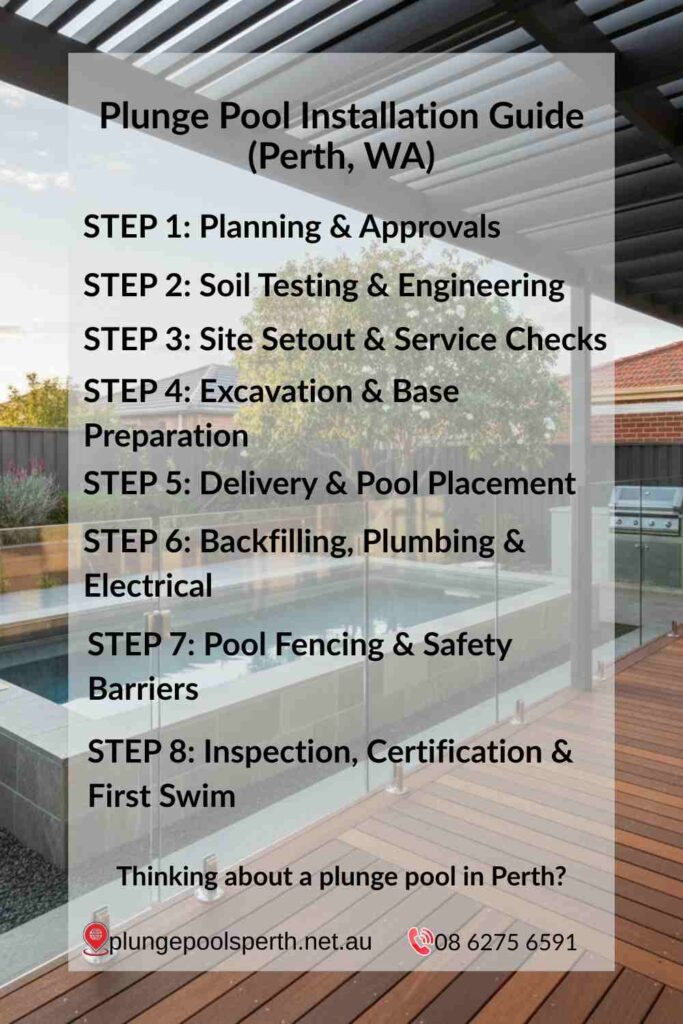
What Are the Different Types of Plunge Pools (and How Does Installation Change)?
There are four main types of plunge pools: precast concrete, fibreglass, poly/modular, and cold plunge pools.
Each installs differently because their weight, structure, and support needs vary, which affects crane access, base design, excavation depth, drainage, and backfill, especially in Perth, where soil ranges from sandy to reactive clay.
Below is a clear breakdown of each plunge pool type, how installation changes, and what to watch out for.
1. Precast Concrete Plunge Pools
Best for:
- Reactive clay or mixed soil
- Long-term durability
- Premium, structural builds
How installation changes:
Precast concrete plunge pools are extremely heavy, often weighing several tonnes before water is added. This means:
- A crane is mandatory
- An engineered base or slab is required
- Excavation depth must allow for drainage layers
- Soil classification directly affects footing design
Main risk if done wrong:
If the base isn’t engineered correctly for Perth soil conditions, the pool can shift, crack, or settle unevenly over time.
2. Fibreglass Plunge Pools
Best for:
- Flat blocks
- Faster installation timelines
- Controlled access sites
How installation changes:
Fibreglass plunge pools are lighter than concrete but still require precision:
- The base must be perfectly level
- Backfill must be placed evenly and gradually
- Water filling and backfilling must happen together to balance pressure once the pool with water and begins to take load
Main risk if done wrong:
Uneven support causes shell stress, which can lead to cracking or deformation — a common issue when shortcuts are taken.
3. Poly / Modular Plunge Pools
Best for:
- Small yards and courtyards
- Restricted access properties
- Budget-conscious builds
How installation changes:
These pools are lighter and often assembled or placed in sections, but that doesn’t reduce structural requirements:
- Strong footings are still essential
- Council approvals are still required
- Base preparation must prevent settlement
Main risk if done wrong:
Weak or poorly compacted footings can cause settlement, leading to tilting or plumbing issues.
4. Cold Plunge Pools
Best for:
- Recovery and wellness use
- Ice bath or cold therapy setups
- Indoor or compact outdoor areas
How installation changes:
Cold plunge pools introduce additional systems:
- Space for a chiller unit
- Safe, compliant electrical connections
- Proper drainage to handle condensation and overflow
Main risk if done wrong:
Poor drainage or unsafe electrics can create safety hazards and compliance issues.
Above-Ground vs In-Ground vs Semi-Recessed Plunge Pools
Above-ground plunge pools:
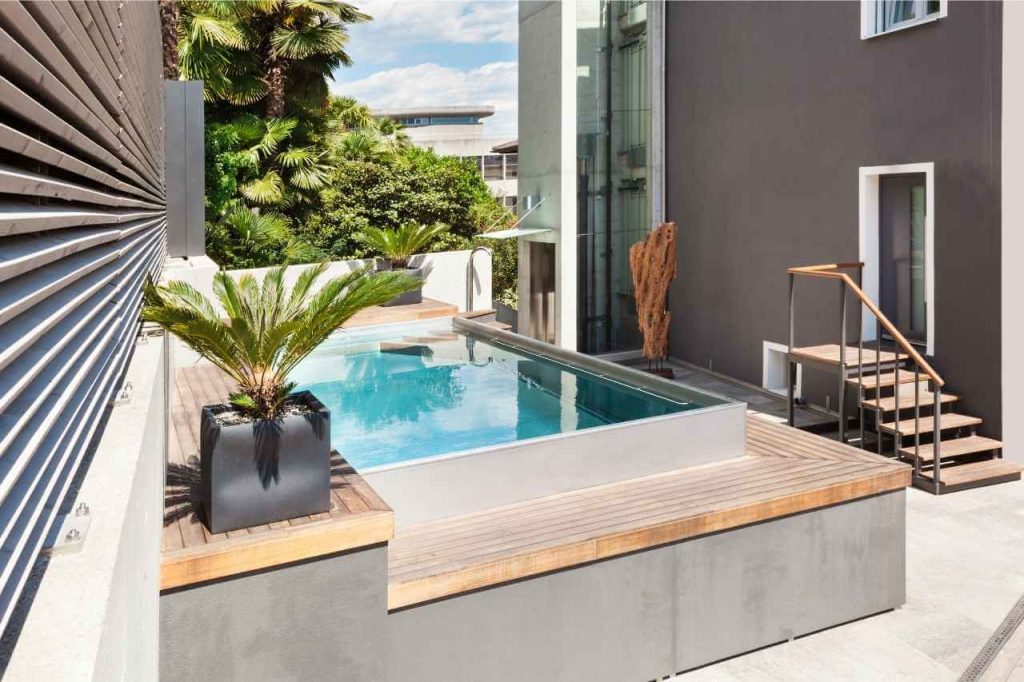
- Still requires council approvals
- Must have compliant fencing
- Easier excavation, but not “approval-free”
In-ground plunge pools:
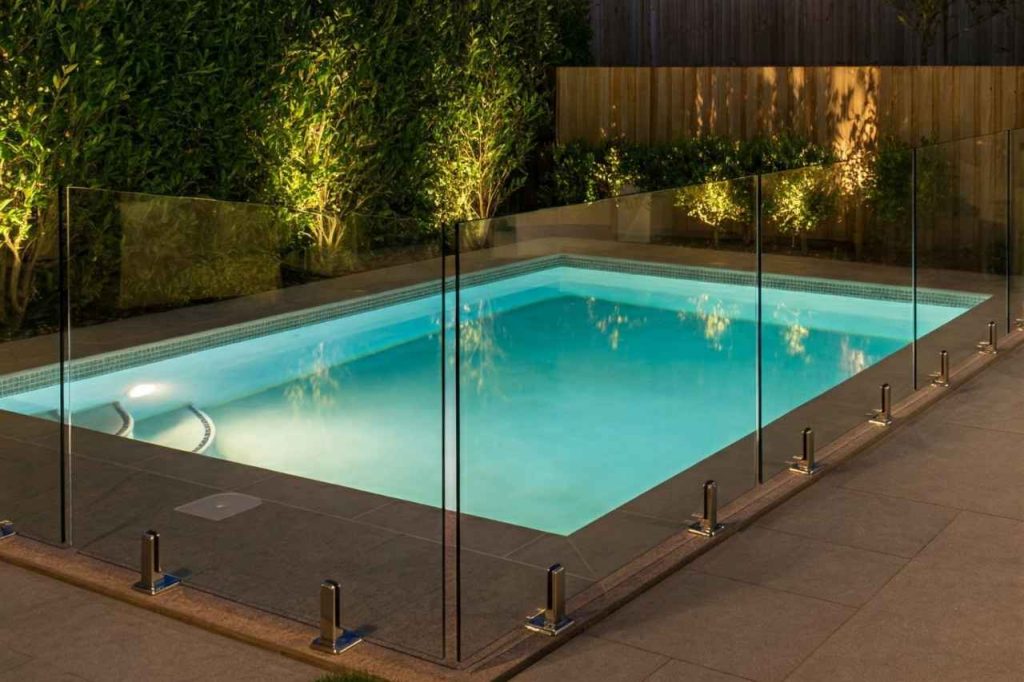
- Require full excavation
- Drainage and backfill are critical
- Most common option in Perth
Semi-recessed plunge pools:
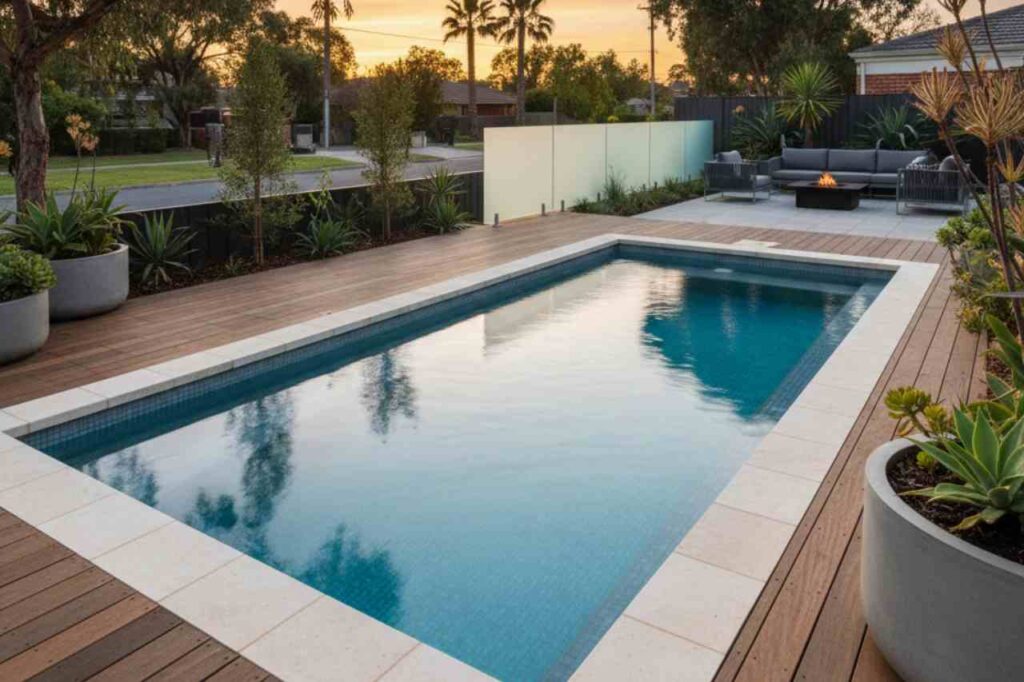
- Change the load forces on the structure
- Require a stronger base design
- Often used on sloping sites
Key takeaway: The more the pool is recessed, the more engineering accuracy matters.
Weight, Access, and Crane Planning
- Pool weight directly affects:
- Crane size and reach
- Access planning
- Installation cost and timing
For example, precast concrete plunge pools must have crane access planned early. If access is overlooked, installations can be delayed or require costly crane rebooking.
How to Choose Between Concrete, Fibreglass & Poly Plunge Pools
The best plunge pool for Perth depends on your site, not just the look.
Key decision factors include:
- Soil type (sand vs reactive clay)
- Slope and drainage
- Crane and access restrictions
- Budget and lifespan expectations
- Intended use (cooling, swimming, or recovery)
A properly matched pool type reduces risk, speeds up installation, and protects your investment long term. One of the advantages of plunge pools overall is their versatile use across cooling, exercise, and wellness applications.
What Legal Approvals Do You Need Before Installing a Plunge Pool in Perth?
All plunge pools (above-ground, in-ground, prefabricated, and cold plunge pools) must comply with Western Australia planning laws, building regulations, and pool barrier rules under AS 1926 before any work begins.
These approvals are assessed by your local council or a private building certifier. While many trades are involved, accountability ultimately rests with the licensed builder, particularly where the homeowner is not acting as an owner-builder.
When Is Approval Mandatory?
Approval is required before:
- Ordering your plunge pool
- Excavating or preparing the base
- Delivering the pool shell
- Installing plumbing, electrics, or fencing
These approvals are assessed by your local council or a private building certifier. While many trades are involved, accountability ultimately rests with the licensed builder coordinating compliance and sequencing.
Who Issues Plunge Pool Approvals in Perth?
Most plunge pool installations require two separate approvals:
1. Planning Approval (Development Approval)
Assesses where the plunge pool can go on your property, including:
- Setbacks from boundaries
- Distance to buildings and retaining walls
- Site coverage and lot zoning
- Heritage or strata restrictions (if applicable)
Not every property needs planning approval, but many do, especially small blocks, courtyards, and inner-city lots.
2. Building Approval
Assesses how the plunge pool is built, including:
- Pool structure and manufacturer specifications
- Soil classification and an engineer-designed base
- Drainage and groundwater management
- Plumbing and electrical compliance
- Pool fencing and safety barriers under AS 1926
Building approval is issued by:
- Your local council, or
- A private building certifier (commonly used for faster processing)
Why Approval Timing Matters
Approvals must be sorted before you order the pool.
Ordering first can lock you into:
- A pool size that breaches setback rules
- A location that fails planning approval
- A design that requires engineering changes
This often leads to:
- Redesign costs
- Delayed installation
- Re-engineering of bases or fencing
- Extra approval fees
In worst cases, the pool must be relocated or modified after delivery.
Pool Barrier & Safety Compliance (AS 1926)
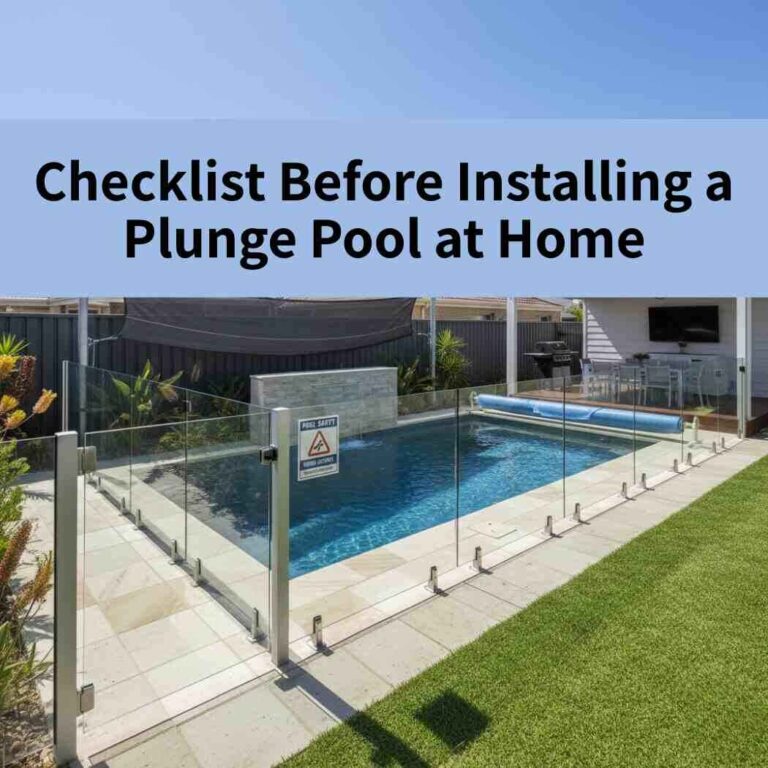
Every plunge pool in Perth must have a compliant safety barrier, including:
- Non-climbable zone of 900mm
- Self-closing, self-latching gates
- Approved fence heights and gaps
Compliance is checked during final inspection, and non-compliant fencing can fail certification, even if the pool itself is perfect.
What Happens If You Install Without Approval?
Installing a plunge pool without approval can result in:
- Stop-work orders
- Council fines and penalties
- Failed inspections
- Forced relocation or removal of the pool
- Mandatory fencing rebuilds
- Insurance refusal
- Issues during property sale or settlement
Retrospective approvals are possible but are slower, more expensive, and not guaranteed.
How Do You Choose the Right Location for a Plunge Pool on Your Property?
The right plunge pool location meets council setbacks, allows crane access, drains water away safely, and won’t affect nearby structures.
1. Site Access and Crane Access (Non-Negotiable)
Most plunge pools in Perth are crane-lifted into position, particularly precast concrete and fibreglass pools.
Your site must allow for:
- Clear space for crane setup and stabilisers
- A safe, unobstructed crane swing path
- No overhead power lines, trees, roof eaves, or pergolas
- Adequate street or driveway access for heavy vehicles
Why this matters:
If crane access is blocked, installation may be delayed, require a larger crane, or become impossible — increasing costs or forcing a redesign.
2. Setbacks, Boundaries, and Council Clearances
Local councils in Perth enforce minimum setback distances for plunge pools.
You may need clearances from:
- Property boundaries
- Dwellings and outbuildings
- Retaining walls
- Easements, sewer lines, and stormwater services
These requirements are assessed during planning and building approval, not after installation.
Key risk:
Placing a pool too close to a boundary or service can result in:
- Failed approvals
- Stop-work orders
- Forced relocation or removal
3. Sun, Shade, and Drainage Conditions
Sun Exposure
- More sun helps naturally warm the plunge pool water
- Excessive shade increases algae growth and maintenance
- Cold plunge pools may prefer shade depending on use
Drainage
Water must drain away from the pool shell
Runoff must not flow toward:
- House footings
- Retaining walls
- Neighbouring properties
Poor drainage can cause soil erosion, pool movement, or shell stress, especially in sandy or reactive soils common in Perth.
4. Distance From Buildings and Retaining Walls
Plunge pools must be located so they do not undermine nearby structures.
Key considerations:
- Excavation must not weaken house footings
- Retaining walls may require engineering checks
- Pools placed too close can cause soil movement or cracking
In many cases, an engineer’s report is required to confirm safe distances.
Mechanism:
Excavation changes soil pressure. If the pool is too close to a structure, it can shift loads and cause long-term damage.
5. Safety and Fence Compliance Zones
Under AS 1926 pool barrier standards, your pool location affects:
- Fence layout
- Gate swing direction
- 900mm non-climbable zones
- Distance from windows, doors, and ledges
Choosing the wrong location can make compliant fencing impossible without costly redesigns.
Final Tip: Choose Location Before You Order
Always finalise:
- Pool location
- Access plan
- Drainage direction
- Setbacks and fencing layout
before ordering the plunge pool.
Ordering first can lock you into a size or shape that cannot legally or physically be installed.
What Setbacks, Boundary Distances, and Clearances Are Required for a Plunge Pool?
Plunge pools must be installed a minimum distance from property boundaries, buildings, retaining walls, and easements, as set by your local council and Australian Standards. These setbacks protect structures, allow safe access, ensure drainage works correctly, and keep the pool compliant and approvable.
Your council may set minimum distances from:
- Property boundaries
- Buildings
- Retaining walls
- Easements and services
Why Distance From Structures Is Critical
Pools must never undermine:
- House footings
- Retaining walls
- Boundary fences
Incorrect placement can cause:
- Structural cracking
- Soil wash-out
- Failed inspections
- Insurance and resale issues
This is why councils often assess location before approval, not after installation.
What Underground Services Must You Check Before Digging a Plunge Pool?
You must check for gas, water, sewer, electricity, and communications services before digging a plunge pool by lodging a BYDA (Before You Dig Australia) request.
BYDA provides service location plans so excavation can be planned safely, legally, and without costly damage.
Why a BYDA Check Is Mandatory Before Excavation
Before any excavation starts—whether for a precast concrete plunge pool, fibreglass plunge pool, or cold plunge—you’re legally and practically required to know what’s underground. Striking a service line can be dangerous, expensive, and can shut down your project instantly.
A BYDA search helps:
- Prevent serious injury or service outages
- Avoid project delays and stop-work orders
- Protect your installer, engineer, and property
- Support council and building approval compliance in WA
Underground Services You Must Check
A BYDA request identifies the likely location of underground infrastructure, including:
- Gas lines – high risk, immediate danger if damaged
- Water mains – breaks cause flooding and soil wash-out
- Sewer and drainage – damage leads to contamination and collapse
- Electrical cables – severe safety risk and power outages
- Telecommunications (NBN, phone, fibre) – costly repairs and delays
These services may run through backyards, side setbacks, easements, or even directly under proposed pool locations.
What You Must Do Before Digging
To stay compliant and avoid delays, follow this process:
- Submit a BYDA request online
It’s free and usually returned within 2 business days. - Review all service provider plans carefully
Each utility supplies its own drawings—don’t assume accuracy or depth. - Mark services on-site
Physically mark service paths before excavation. - Confirm the dig zone is safe
Your installer or engineer should verify clearances before the machinery starts.
BYDA plans show approximate locations only. Non-destructive digging may still be required near services.
Why Service Clashes Stop Plunge Pool Projects
If underground services conflict with your planned plunge pool location:
- Excavation must stop immediately
- The pool position may need to change
- Engineering redesign may be required
- Service relocation may be needed (extra cost, approvals, time)
This is a common reason plunge pool installations in Perth are delayed or redesigned after excavation begins.
Why BYDA Also Matters for Your Pool Base and Longevity
Digging too close to underground services doesn’t just create legal risk—it can compromise the structural performance of your plunge pool.
Poor service clearance can:
- Weakened soil support under the pool base
- Disrupt drainage and cause water pooling
- Increase the risk of settlement or movement
- Lead to cracking or shell stress over time
BYDA information allows engineers to design the correct base, drainage, and setbacks, ensuring your plunge pool remains stable and compliant long after installation.
Why Is Soil Testing and Engineering Critical Before Installing a Plunge Pool?
Soil testing is critical because it tells engineers how to design a plunge pool base that won’t move, sink, or crack over time.
Why Soil Testing Is Essential in Perth
Perth has some of the most variable soil conditions in Australia. Assuming “all Perth soil is sandy” is one of the biggest reasons plunge pools fail.
Common Perth soil types include:
- Coastal sand – drains well but can collapse or wash away if not compacted correctly
- Reactive clay (inland areas) – expands when wet and shrinks when dry
- Mixed or filled ground on older blocks – unpredictable and often poorly compacted
A soil test identifies which of these conditions applies before excavation begins, so the base and drainage can be designed correctly.
What a Geotechnical Report Tells You
A geotechnical (soil) report gives engineers the data they need to design a safe, compliant plunge pool base.
It typically explains:
- Soil type and load-bearing strength
- Drainage behaviour (how water moves through the ground)
- Expected ground movement (especially in reactive clay)
- Depth of stable ground suitable for footings or base support
This report directly informs:
- Base thickness and material (gravel, reinforced slab, or engineered system)
- Drainage design around the pool
- Whether extra reinforcement or deeper excavation is required
Without this information, installers are guessing—and pools crack when guesses are wrong.
Mechanism: How Soil Movement Damages Plunge Pools
Soil moves because moisture changes.
- Wet soil swells
- Dry soil shrinks
This expansion and contraction put pressure on:
- The pool shell
- Plumbing penetrations
- Skimmer and return lines
Over time, uneven pressure causes:
- Pool shells to tilt or drop
- Hairline cracks that grow into structural damage
- Plumbing leaks beneath the pool
Engineering works by spreading the pool’s weight evenly and isolating it from ground movement, so the shell stays level even when the soil shifts.
Why “Standard Bases” Fail
There is no such thing as a one-size-fits-all plunge pool base.
A “standard” base that works in:
- Free-draining sand
may completely fail in: Reactive clay or filled ground
When bases aren’t engineered:
- Pools can settle unevenly
- Cracks may appear months or years later
- Repairs are expensive and often not covered by warranty
Soil testing ensures the base matches the actual site conditions, not assumptions.
Should a Plunge Pool Sit on Gravel or a Concrete Slab?
A plunge pool can sit on compacted gravel or a concrete slab, but the right base depends on the pool type, soil test results, weight of the pool, and drainage conditions. Light fibreglass pools on stable sand may suit gravel, while heavy precast concrete pools or reactive clay sites usually need an engineered concrete slab.
Option 1: Compacted Gravel / Crusher Dust Base
A compacted gravel base is commonly used for lighter plunge pools on stable ground.
Best suited for:
- Fibreglass plunge pools
- Poly or modular plunge pools
- Flat sites with clean, free-draining sand
- Sites with a low water table
Key requirements:
- Correct gravel type (not loose sand)
- Layered compaction to engineering density
- Laser-level finish
- Subsurface drainage to move water away
Risks if done wrong:
- Uneven settlement
- Pool shell stress
- Long-term movement after heavy rain
A gravel base is not “cheap and easy” — it only works when soil conditions allow it.
Option 2: Concrete Slab Base
A concrete slab base is used for heavier pools or challenging soil conditions.
Best suited for:
- Precast concrete plunge pools
- Reactive clay or mixed soils
- Sloping sites
- Areas with poor natural drainage
What matters most:
- Slab thickness designed to pool weight
- Reinforcement (mesh or bars)
- Allowance for soil movement
- Drainage layers or spoon drains beneath or around the slab
Why slabs fail when not engineered:
- Cracking from soil heave
- Water trapped under the slab
- Differential movement pushing against the shell
A “standard slab” is often not enough — slabs must match the soil report.
Option 3: Engineered Base Systems (Hybrid Designs)
Some sites need a custom-engineered base, combining gravel, concrete beams, piers, or drainage layers.
Typically required when:
- Soil test shows reactive clay
- Fill material exists on older blocks
- The pool sits near retaining walls or structures
- Groundwater or drainage is a concern
Why this works:
- The load is spread evenly
- Movement is controlled, not resisted
- Drainage is built into the system
Engineered bases are designed from geotechnical data — not rules of thumb.
Drainage Is Part of the Base (Not an Add-On)
Poor drainage is one of the most common causes of plunge pool failure.
When water gets trapped under a pool:
- Clay soils swell
- Sandy soils soften
- Pressure builds against the shell
- Movement increases over time
A good plunge pool base design always includes:
- Free-draining layers
- Fall away from the pool
- Controlled discharge points
- Protection from roof or surface runoff
Quick Decision Guide (Recap)
- Light fibreglass + stable sandy soil → Compacted gravel base may be suitable
- Heavy precast concrete pool → An engineered concrete slab is usually required
- Reactive clay, fill, or poor drainage → Engineered base system essential
How Deep Should You Excavate for a Plunge Pool — and What Clearances Are Required?
You must excavate a plunge pool deep enough to fit the pool shell, the engineered base thickness, and the finished surface levels around the pool, while also allowing side clearances for plumbing, backfilling, compaction, and inspections. Excavation depth and clearances must match the engineering plans exactly to avoid delays, rework, or future settlement.
How Deep Do You Need to Excavate for a Plunge Pool?
Plunge pool excavation depth is not a standard measurement. It is calculated from the engineering design and includes multiple layers, not just the pool shell.
Your excavation depth must allow for:
- Pool shell height
The full external height of the plunge pool, not just the internal water depth. - Base thickness
This may be: - Compacted crusher dust or gravel
- An engineered concrete slab
- A hybrid engineered base system
Base thickness commonly ranges from 75 mm to 200+ mm, depending on soil conditions.
Finished surface levels
Allowance for:
- Paving, concrete, or decking
- Drainage falls away from the pool
- Compliance with finished ground levels shown on plans
Example:
A 1.5 m-high pool shell + 100 mm engineered base + 50 mm finished surface allowance = 1.65 m excavation depth (minimum).
What Clearances Are Required Around a Plunge Pool?
Excavation is wider than the pool shell itself. Clearances are essential for correct installation and long-term performance.
You must allow space for:
- Plumbing connections
Room to install suction, return, overflow, and drainage lines without forcing pipes against soil. - Backfill placement and compaction
Proper backfilling cannot be done if the excavation is too tight. Poor compaction leads to settlement and shell stress.
Inspection and certification access
Building surveyors and engineers must be able to visually confirm:
- Base preparation
- Pool placement
- Plumbing and structural compliance
Typical side clearances range from 300 mm to 600 mm, depending on pool type and site conditions.
Common Risk: Over-Excavation
Over-excavation is one of the most common and costly plunge pool mistakes.
If digging goes past the engineered depth:
- Loose soil at the base must be removed
The area must be rebuilt using:
- Engineered compacted fill (layered and tested), or
- Concrete to restore design levels
Skipping this step invites future problems, including:
- Pool settlement
- Cracking or shell stress
- Plumbing failures
- Failed inspections
Simply “throwing soil back in” is not compliant and will almost always lead to movement later.
Delivery & Crane Planning: The Most Expensive Day of Your Plunge Pool Installation (If Done Wrong)
Crane day is the single highest-risk and highest-cost stage of a plunge pool installation. Everything built before approvals, excavation, base preparation, and access planning exists to make this one lift go smoothly. If crane access is misjudged or site conditions aren’t ready, costs can escalate fast, and the installation can stall.
Why Crane Planning Matters So Much
A crane hire operates on strict time windows. Once the crane arrives on site, the clock starts—whether the pool can be lifted or not.
If something goes wrong:
- The crane may sit idle while problems are fixed
- Additional lift time is charged by the hour
- The crane may need to return another day
- Pool delivery vehicles may incur waiting fees
This is why crane day is often the most expensive single day of the entire plunge pool build if it’s not planned correctly.
Typical Crane Hire Costs in Perth
While prices vary by contractor and site conditions, typical crane hire costs in Perth usually fall within these ranges:
- $500–$1,500+ for standard residential lifts
Higher costs for:
- Longer reach requirements
- Heavier precast concrete shells
- Restricted access or tight suburban blocks
- Extended lift times
Costs increase further if:
- A larger crane is needed on the day
- Multiple lifts are required
- The crane has to return due to failed access
Proper lift planning is the key to keeping crane hire within budget.
What a Proper Lift Plan Must Include
Crane planning is not just “booking a crane.” A professional lift plan should account for all physical, safety, and logistical factors before delivery day.
Crane Size and Capacity
The crane must be rated for:
- The full pool weight, not just the shell
- Any additional rigging gear
- The required reach distance
Precast concrete plunge pools can weigh several tonnes, which often rules out smaller cranes. Undersizing the crane is one of the most common and expensive mistakes.
How Professional Planning Protects Your Budget
A properly planned crane lift:
- Uses the correct crane the first time
- Confirms access and swing paths in advance
- Accounts for soil and ground conditions
- Minimises lift time
- Reduces weather-related risk
This level of planning turns crane day from the most stressful part of the project into a controlled, predictable step.
How Is a Plunge Pool Shell Set Correctly During Installation?
A plunge pool shell is set correctly when it is fully level in all directions, aligned to the approved plans, and checked for plumbing clearance before the crane releases the load, ensuring the pool installed matches the approved design exactly.
Installation must be carried out by skilled operators to avoid long-term structural and compliance issues.
What Installers Check
- Level in all directions
- Orientation matches approved plans
- Plumbing clearance is correct
Why Level and Alignment Matter
When a plunge pool shell is not level:
- Water pressure is distributed unevenly along the walls and floor
- One side of the shell carries more load than designed
- Long-term stress increases the risk of cracking, flexing, or plumbing failure
Uneven shells also create:
- Sloping waterlines that look unfinished
- Drainage issues around coping and paving
- Difficulty achieving compliant fencing and finishes
How Should a Plunge Pool Be Backfilled to Prevent Cracks and Shell Stress?
A plunge pool must be backfilled in stages while the pool is filled with water at the same time.
This balances pressure on the shell from both sides, preventing cracking, distortion, and long-term structural stress.
The Correct Method
- Add water in stages
- Add backfill at the same pace
- Compact each layer
- Use drainage-friendly material
Backfill Material Must
- Drain freely
- Compact well
- Do not trap water against the shell
Common Mistakes
- Filling the pool too fast
- Uneven backfill
- Poor drainage or wrong material
What Plunge Pool Plumbing Is Pre-Fitted — and What Must Be Installed On-Site?
Plunge pool plumbing in Western Australia must be completed by a licensed plumber.
Most plunge pools arrive with key fittings moulded or cast into the shell, but all pipework, valves, and equipment connections are installed on-site to suit your property layout and equipment location.
Usually Pre-Fitted in the Shell
- Skimmer box
- Return jets
- Suction points
Installed On-Site
- Pipework to pump and filter
- Valves for flow control
- Waste and drainage lines
Why Plunge Pool Plumbing Layout Matters
A poorly designed plumbing layout can cause long-term problems, even if the pool shell itself is installed perfectly.
Bad plumbing design can lead to:
- Noisy pumps from restricted or unbalanced flow
- Weak water circulation and dead spots
- Higher electricity costs due to pump strain
- Premature wear on pumps, filters, and heaters
- Difficult or expensive future maintenance
In Perth and across WA, plumbing layout must also account for soil movement, drainage, and equipment clearances to avoid pipe stress or leaks over time.
What Electrical Work and Equipment Must Be Installed Safely for a Plunge Pool?
All plunge pool electrical work must be carried out by a licensed electrician.
DIY electrical work on a plunge pool is illegal in WA, unsafe around water, and can void warranties, insurance, and compliance approvals.
Common Electrical Needs
- Pump and filter power
- Lighting (if included)
- Heat pump or chiller
- Timers and controls
Safety Requirements
- RCD protection (safety switches)
- Correct earthing and bonding
- Proper isolation points
Why Must Pool Fencing and Safety Barriers Be Installed Before Filling a Plunge Pool?
Pool fencing and safety barriers must be installed before a plunge pool is filled, even partially, because Australian law treats any body of water capable of holding 300 mm or more as a safety risk. All barriers must comply with AS 1926, including compliant fence height, self-closing and self-latching gates, and a clear 900 mm non-climbable zone (NCZ). Filling a pool before compliant fencing is in place can lead to failed inspections, fines, stop-work orders, and serious safety risks.
Key Rules
- Fence height and spacing must meet the standard
- Gates must self-close and self-latch
- Temporary fencing must also comply
The 900mm Non-Climbable Zone (NCZ)
Keep 900mm clear of climbable items like:
- Pots
- Chairs
- Retaining walls
- Deck edges or steps
Surrounds, Decking & Landscaping Without Breaking Compliance
Decking, paving, and landscaping can turn a compliant plunge pool into a non-compliant pool barrier if they’re not planned correctly. In Perth and across WA, pool inspectors assess the entire pool area, not just the pool shell or the fence itself. That means decking heights, garden layouts, furniture placement, and even pot plants can cause a failed inspection if they reduce fence effectiveness or breach the Non-Climbable Zone (NCZ) under AS 1926.
Common Compliance Mistakes
- Decks built too close to the fence
- Pots or seating placed in the NCZ
- Raised paving reducing effective fence height
How to Design Pool Surrounds That Stay Compliant
Plan Finished Levels First
Always design:
- Deck height
- Paving thickness
- Landscaping levels
before fence installation.
This avoids costly fence modifications later.
What Happens During the First Fill and Water Balancing of a Plunge Pool?
The first fill of a plunge pool is when the pool is slowly filled, the circulation system is switched on, and the water chemistry is balanced to protect the pool surface and equipment. During this stage, installers check for leaks, run the filter to remove construction residue, and adjust pH, alkalinity, and sanitiser levels. Proper water balancing prevents staining, corrosion, cloudy water, and early equipment damage. Most plunge pools are safe to use within 24–48 hours once the water is stable and the system is running correctly.
What Happens
- The pool fills gradually
- Filter runs to clear residue
- Leaks and equipment are checked
Water Balancing Basics
- pH and alkalinity are adjusted
- Sanitiser levels are set
Balanced water helps prevent staining, corrosion, and cloudy water.
When Can You Use It?
Many plunge pools are ready within 24–48 hours once water is stable and the system is running correctly.
Cold Plunge Setup: Temperature, Equipment & Safe First Use
Cold plunge pools deliver powerful recovery and wellness benefits, but only when the setup is done correctly. From choosing the right water chiller to setting safe cold plunge temperatures and commissioning the system properly, each step affects performance, safety, and long-term reliability.
Common Cold Plunge Equipment
- Water chiller
- Digital temperature controls
- Insulated plumbing
Safe First Use
Start mild, then go colder slowly. Short dips first. Comfort and safety come first.
Final Inspection, Certification & When You’re Legally Allowed to Swim
Before you jump into your new plunge pool, there is one final and legally critical step: final inspection and certification. In Perth and across Western Australia, you must not use your pool until final certification is issued. This inspection confirms that the pool, safety barriers, and all related works comply with state legislation, local council requirements, and Australian Standards.
Inspectors Check
- Pool placement and structure
- Fencing, gates, and NCZ
- Electrical and plumbing compliance
What You Receive
- A compliance or occupation certificate
- Updated council records
- Insurance and warranty activation
DIY vs Professional Plunge Pool Installation: Real Risks, Real Costs, and What WA Homeowners Need to Know
Installing a plunge pool can look simple online. Many homeowners in Western Australia consider a DIY plunge pool installation to save money. On paper, it seems cheaper. In reality, DIY pool installation often costs more once mistakes, compliance issues, and repairs are factored in.
Working with licensed trades and a reputable installer provides clear accountability, warranty protection, and compliance certainty.
DIY Risks
- Failed inspections
- Voided warranties
- No insurance cover
- Expensive repairs later
Benefits of Professional Installation
- Correct approvals and engineering
- Licensed plumbing and electrical
- Warranty and clear accountability
Plunge Pool Installation Timeline in Perth: How Long Each Stage Really Takes
Installing a plunge pool in Perth is not a one-day job, even though the physical installation may appear quick. In reality, most delays occur well before excavation begins, during the approvals, planning, and engineering phases. Understanding the full installation timeline helps you plan realistically, avoid costly delays, and keep your project compliant with WA regulations.
Here’s a typical timeline:
| Stage | Typical Time |
| Approvals + planning | Several weeks |
| Soil test + engineering | 1–2 weeks (varies) |
| Excavation + base | A few days |
| Delivery + placement | 1 day |
| Plumbing + electrical + backfill | Several days |
| Fencing + final inspection | Final stage |
What Mistakes Should You Avoid When Installing a Plunge Pool?
The biggest mistakes include ordering before approvals, skipping soil testing, poor drainage planning, rushing backfill and water balancing, and installing fencing too late. Avoiding these errors is the key to a plunge pool that is compliant, structurally sound, and trouble-free long term.
Avoid these top mistakes:
- Ordering before approvals
- Skipping soil testing
- Poor drainage planning
- Rushing backfill and water balancing
- Building fencing too late
Conclusion
A plunge pool should be something you enjoy, not worry about. When the installation follows the correct sequence, the result is a pool that is safe, legal, and built to last in Perth conditions.
By understanding approvals, soil, access, and safety rules, you avoid costly mistakes and delays. With the right planning and professional support, your first dip can be taken with confidence.
If you’re planning a plunge pool and want expert guidance from start to finish, reach out to Plunge Pools Perth. We offer full installation services and can help you request a quote that suits your home, your site, and your goals.
FAQs
1. Do I need council approval to install a plunge pool in Perth?
Yes, council approval is required to install a plunge pool in Perth. All plunge pools, regardless of size or type, must meet WA planning and building rules, including safety fencing under Australian Standards. Installing without approval can lead to fines, stop-work orders, or forced changes.
2. Is my backyard and soil suitable for a plunge pool?
Most Perth backyards are suitable for a plunge pool, but soil testing is essential.
Soil type, drainage, access, and setbacks determine what can be built. A soil test and site assessment confirm whether the ground can safely support the pool long term.
3. Which plunge pool type is best for Perth conditions: concrete or fibreglass?
Precast concrete plunge pools are generally better for Perth’s soil conditions. They are heavier, more stable, and handle ground movement well. Fibreglass pools suit flat, stable sites but require precise installation to avoid movement or stress.
4. How much does it really cost to install a plunge pool in Perth?
Plunge pool installation in Perth typically costs between $45,000 and $70,000 or more. The final price depends on pool type, soil conditions, access, crane hire, approvals, fencing, and equipment. Accurate pricing requires a site-specific assessment.
5. What happens if a plunge pool is installed without approval or compliance?
Installing a plunge pool without approval is illegal in Perth. You may face fines, failed inspections, insurance issues, or be ordered to modify or remove the pool. Compliance protects safety, property value, and your legal position as a homeowner.